Proper care and maintenance of the shelter is
described in NAVAIR 50-30FR-518, Operation and
Maintenance, Standard Air, Maximum and Minimum
Thermometers, Townsend Support, Sling and Rotor
Psychrometers, and Instrument Shelters. The routine
care of the shelter includes keeping it free of dirt and
debris and oiling the door hinges.
Backup equipment usually kept inside the shelter
includes the rotor, sling or electric psychrometers, and
maximum and minimum thermometers mounted on a
Townsend support. When the temperature is above
freezing, a bottle of distilled water is also included for
the psychrometers.
REVIEW QUESTIONS
Q9.
What is the purpose of the ML-41 instrument
shelter?
Q10.
What tasks are included in the routine care for
the instrument shelter?
THERMOMETERS
LEARNING OBJECTIVES: Describe the char-
acteristics of liquid-in-glass thermometers.
Explain how to properly read a thermometer.
Identify three types of liquid-in-glass
thermometers.
Liquid-in-glass thermometers, such as alcohol or
mercury thermometers, are found throughout the Navy
and Marine Corps in various configurations. Some are
simply closed glass tubes mounted on a graduated
cardboard, plastic, or metal backing, and others have the
graduations etched into the glass. For meteorological
and oceanographic readings, calibrated thermometers
with the graduations permanently etched into the glass
are recommended, since they are considered the most
accurate.
In meteorology and oceanography, liquid-in-glass
thermometers are used in the rotor psychrometer, the
sling psychrometer, electric psychrometers, and as
simple thermometers for measuring seawater
temperature by the bucket method. The maximum and
minimum thermometers found in the instrument shelter
are special types of liquid-in-glass thermometers. Both
NAVMETOCCOMINST 3141.2 and NAVMET-
OCCOMINST 3144.1 provide detailed instructions for
use and care of the different types of thermometers.
READING A THERMOMETER
Accuracy is the goal when making any temperature
reading. To obtain an accurate reading, you must read
the thermometer properly. Be sure the thermometer is
clean, and allow the instrument to acclimatize prior to
reading. Keep the following points in mind when
reading temperatures:
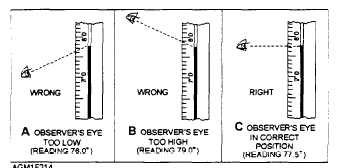
The temperature indicated by a liquid-in-glass
thermometer should be read to the nearest 1/10 of a
degree at the top of the meniscus, with the eye looking
straight at the fluid level (fig. 2-14) to avoid parallax
error.
Avoid obvious scale errors in reading. Errors of
5 or 10 degrees are more common than errors of 1 or 2
degrees.
Do not allow any moisture to accumulate on a
dry-bulb thermometer. Protect the thermometer from
spray and precipitation.
Do not hold a thermometer too close to your
body or near a heat source, such as a light bulb or direct
sunshine. Always stand downwind of a thermometer.
When the air temperature is below freezing, wait
at least 15 minutes after wetting the wet-bulb wick
before using a wet-bulb thermometer. This allows the
water to freeze on the wick to prevent false high
readings.
ROUTINE CARE
Routine care of thermometers is limited to keeping
the glass clean. When using a thermometer to measure
wet-bulb temperature, keep the cotton wick clean. A
weekly wipe down of glass thermometers with
freshwater is usually sufficient. At sea, especially
under windy conditions, minute salt crystals tend to
accumulate on the thermometers. These crystals readily
Figure 2-14.—Reading a thermometer to avoid parallax
error.
2-9